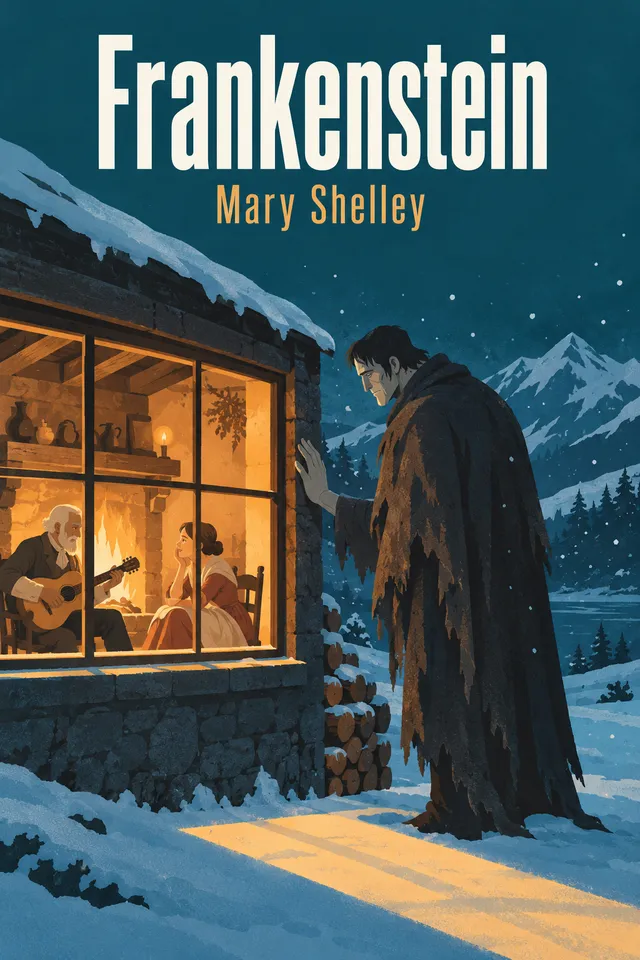
What you'll learn
Key ideas from Frankenstein
These ideas compress the book's argument without treating the author's view as settled fact. Use them as an orientation before reading the full work or listening in Wiseley.
Years of preparation and a private hunger for glory coexist with Walton’s recognition that he needs a friend to steady his judgment.
His imagined gratitude from a new species comes with the neglect of family, health, nature, and ordinary pleasure.
The villagers’ attack teaches him fear, while observing the De Laceys’ hardship turns sympathy into secret service.
De Lacey’s welcome based on speech offers hope, while Felix’s attack shows how quickly it collapses when the family sees the Creature.
Fearing possible violence, rejection, and descendants, Victor destroys the unfinished companion; those feared outcomes remain uncertain.
Victor mistakes the wedding threat for an attack on himself, leaving Elizabeth uninformed and exposed to the danger he misreads.
Walton turns south when the ice opens a passage, accepting responsibility for his crew despite his sense of defeat.
The Creature connects rejection and envy to his violence, confesses his crimes, and plans a death Walton cannot confirm.
Inside Frankenstein
Read the first chapter in full here. The other 8 continue in the Wiseley app.
Chapter 1 of 9 · 7 min · Audio & text
Ambition at the Pole
Frankenstein, by Mary Shelley.
Mary Shelley opens with letters from Robert Walton to his sister, Margaret Saville. At the start of his expedition toward the North Pole, Walton presents discovery as a service to humanity. He hopes to understand the force that draws the compass needle, settle questions about the heavens, and perhaps find a passage that could shorten voyages to distant countries. Yet he also imagines the pole as a place of perpetual light, calm seas, and marvels. Those pictures express his hopes, not what he has seen. His direct evidence so far is a northern climate he welcomes and a journey still ahead.
The expedition is the return of a dream Walton has held since youth. He once sought literary fame through poetry, but disappointment and an inheritance redirected him toward exploration. He prepared over several years: enduring hardship on northern voyages, working with whale-fishers, and studying subjects useful to a naval adventurer. He twice served as an under-mate on Greenland whalers. Even with this preparation, he asks whether he deserves a great purpose. He has chosen glory over ease, and his confidence rises and falls as he considers the danger and uncertainty of a voyage that could keep him away for years.
Walton has hired a ship and gathered sailors he considers dependable and courageous, but he still feels alone. He longs for a friend with a cultivated mind who can share success and disappointment, assess his plans, and correct them when needed. He describes himself as self-educated, with broad, imaginative thoughts that lack discipline and balance. He admits he can be too ardent in carrying out a plan and impatient with difficulties. His wish for friendship is therefore practical as well as emotional: he wants affection joined to sound judgment, someone able to steady a mind he knows can run ahead of its restraints.
The ship’s master offers Walton an example of generosity that does not serve personal advantage. The master loved a woman who preferred another man. He gave that rival his farm and the remains of his prize money, then sought her father’s consent to their marriage. When permission was refused, he left the country; he returned only after learning that the woman had married as she wished. Walton admires his integrity, courage, and gentle authority, and chose him to lead the ship. The master is not a perfect ideal in Walton’s eyes: Walton also notes his lack of education and taciturn manner. Still, this renunciation contrasts with the glory Walton seeks for himself.
As the ship advances, Walton promises to be cool, persevering, and prudent. He says he will not act rashly and recognizes that the crew’s safety rests in his care. By July, the expedition has reached a high latitude. Walton reports floating ice, temperate winds, stiff gales, and a leak, but no discovery that confirms his visions of the pole. His letters nevertheless turn from caution to triumphal resolve: he speaks of pressing onward across the sea and asks what could stop a determined will. The tension is already present between his stated duty to protect others and his confidence in his own ambition.
In thick fog, ice nearly surrounds the ship. When the mist lifts, the crew sees a vast plain of ice and a gigantic human-shaped figure traveling north on a dog-drawn sledge. The figure disappears beyond the ice. About two hours later, before night, the ice breaks and frees the ship. Fearing the loose masses in the dark, the crew waits until morning to move. At daylight, Walton finds another sledge drifting on a fragment of ice. One dog is alive; its human passenger is near death. Walton cannot tell whether the first traveler survived the breakup, leaving that pursuit unresolved.
The rescued man is a European; the first traveler had seemed to be a savage inhabitant of some undiscovered island. Before accepting help, he asks where the ship is headed. When Walton says it is bound for the North Pole, the stranger agrees to come aboard. Emaciated and nearly frozen, he faints in the cabin and takes days to recover. Walton gives him warmth and food, protects him from the crew’s curiosity, and waits for him to regain his strength. The stranger says he had been seeking someone who fled from him. When he learns the crew saw another sledge, he urgently asks about its route and calls its traveler a dæmon. Walton cannot say whether the ice destroyed that sledge.
Walton grows attached to the stranger, seeing gentleness beneath his despair. He also tells the stranger how much he is willing to stake on the expedition: his fortune, his existence, and his hopes. More strikingly, he says that even one person’s life or death is a small price for the knowledge and mastery over nature he seeks. The stranger responds with tears, calls Walton unhappy, and asks whether he shares the stranger’s madness. He urges Walton to hear his tale, saying it may make him reject the pursuit. His grief makes the cost of Walton’s ambition visible. Walton had promised to protect those in his care; now his own words place knowledge above an individual life.
The stranger does not answer Walton’s ambition with a simple command to turn back. He asks about Walton’s early life, listens to his longing for friendship, and agrees that a wise and dear friend can help correct human weakness. He says he once had such a friend, but has lost everything and cannot begin again. He now agrees to tell his history because Walton seeks knowledge and faces similar dangers. He hopes the account may guide Walton if his expedition succeeds, or console him if it fails. Walton plans to record the stranger’s story as nearly as possible in his own words. His letters thus frame a history offered as a warning, while leaving the promised discoveries, and the fate of the first sledge traveler, unsettled.
Chapter 2 of 9 · 9 min · Audio & textIn the app
How Victor Learned to Want
Victor presents his early life as both a home of care and the beginning of an appetite that will eventually outgrow it. His family gives him a secure upbringing, but he says his strongest passions are intense and fixed on learning.
Chapter 3 of 9 · 7 min · Audio & textIn the app
The Work of Making Life
Victor says his discovery came through stages, not as a complete creation suddenly revealed to him. After studying how life begins and ends, he came to believe he had found its cause and could animate lifeless matter.
Chapter 4 of 9 · 7 min · Audio & textIn the app
Silence, Evidence, and Guilt
William’s death brings Victor close to the truth, but what he knows remains private. Justine is judged on a case that looks convincing to others, even though the evidence does not establish her guilt.
Chapter 5 of 9 · 10 min · Audio & textIn the app
The Creature Learns Humanity
When Victor meets the Creature on the glacier, he responds with hatred and calls him a murderer. The Creature asks him to listen before judging.
Chapter 6 of 9 · 9 min · Audio & textIn the app
A Companion and a Bargain
After learning from the De Lacey household, the Creature turns to books for a wider picture of human life. He finds three volumes: The Sorrows of Werter, Plutarch’s Lives, and Paradise Lost.
Chapter 7 of 9 · 8 min · Audio & textIn the app
The Promise Breaks
After returning to Geneva, Victor lets weeks pass without restarting his work. He fears the Creature’s revenge if he refuses, yet feels repugnance at making another being.
Chapter 8 of 9 · 7 min · Audio & textIn the app
The Misread Threat and the Turn to Pursuit
After returning from Ireland, Victor is too depleted to travel without rest. His father tends to him, but cannot reach the source of his despair.
Chapter 9 of 9 · 11 min · Audio & textIn the app
Revenge and the Last Choice
With Victor rescued from the ice and aboard Walton’s ship, the story returns to the frame that first received him. Walton records Victor’s account of a pursuit that began after his family’s deaths and was interrupted when his strength failed in the Arctic.
Chapter 1 of 9 · 7 min · Audio & text: Ambition at the Pole
Wiseley supports reading and listening to summaries in the app.
Continue in WiseleyWhat Frankenstein is about
Mary Shelley’s Frankenstein follows Victor Frankenstein and the being he creates through ambition, abandonment, exclusion, guilt, and revenge. It asks what a maker owes a life brought into the world, how rejection shapes conduct without erasing responsibility, and when concern for others should limit a pursuit of knowledge. Its layered testimonies invite careful judgment of evidence and self-justification.