What you'll learn
Key ideas from The Picture of Dorian Gray
These ideas compress the book's argument without treating the author's view as settled fact. Use them as an orientation before reading the full work or listening in Wiseley.
The preface treats art as formally judged and independent of moral instruction, while allowing virtue and vice to serve as artistic materials.
Seeing his portrait makes Dorian feel the future loss of his beauty and voice a wish for the image to age in his place.
Dorian’s attachment depends on Sibyl sustaining the artistic ideal he has made of her.
Dorian covers and locks away the portrait, making control over who sees it his first sustained defense against its accusation.
After killing Basil, Dorian hides his belongings and relies on the account that Basil left at eleven for his intended midnight train to Paris.
Dorian turns to opium and ugliness to silence memory, treating atonement as impossible and forgetting as a choice.
Dorian tries to destroy the portrait as evidence and conscience; it regains its youthful likeness while his aged body is found dead.
Inside The Picture of Dorian Gray
Read the first chapter in full here. The other 10 continue in the Wiseley app.
Chapter 1 of 11 · 6 min · Audio & text
Art, Beauty, and the Artist
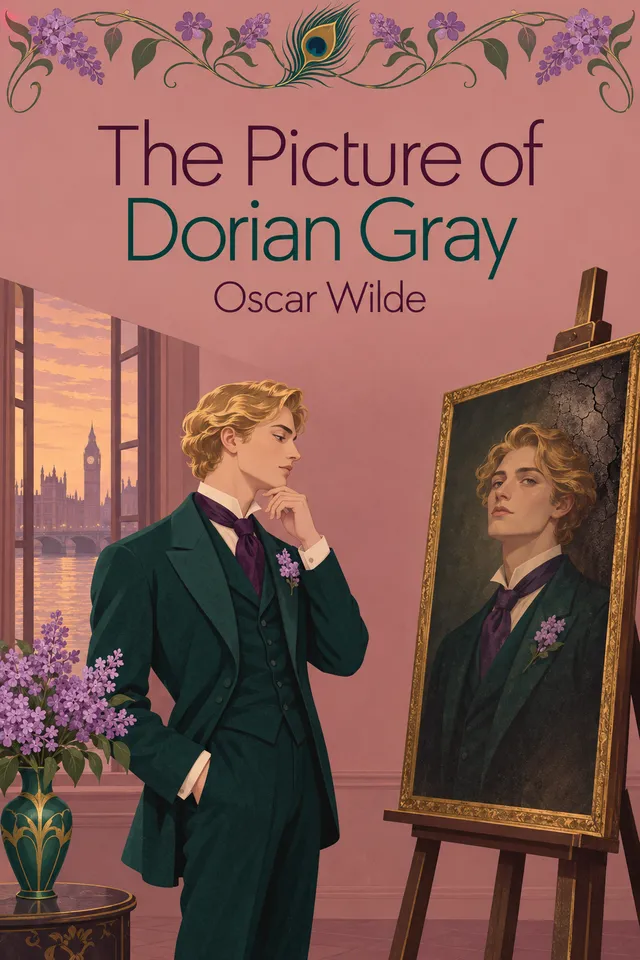
The Picture of Dorian Gray, by Oscar Wilde.
The preface to The Picture of Dorian Gray presents art as an independent creation. The artist makes beautiful things, and art’s purpose is to reveal art while concealing its maker. A book, the preface argues, is neither moral nor immoral; it is well written or badly written. Moral life is part of an artist’s subject matter, but the morality of art lies in the perfect use of an imperfect medium. Thought and language are instruments of art, while virtue and vice are materials for it.
This account resists treating a work as a lesson or a confession. Art does not have to prove a point, and the preface calls it useless: the only excuse for making a useless thing is that one admires it intensely. Yet art is also both surface and symbol. Those who go beneath the surface or read the symbol do so at their peril, because a response to art may reveal more about the spectator than about life itself. Criticism, in this view, translates an impression into another form and becomes a kind of autobiography. The preface therefore protects art’s autonomy while making interpretation personal.
Basil Hallward’s portrait of Dorian Gray puts that ideal under pressure. In his studio, Basil’s friend Lord Henry praises the portrait and urges him to exhibit it. Basil refuses. He says he has put too much of himself into the work, though Henry sees no physical resemblance between painter and sitter. Basil’s explanation is not about likeness. He fears that viewers will recognize his devotion in the portrait and examine his heart through it.
Basil describes Dorian as more than a model. Since meeting him, Basil says, he has found a new manner and style. Dorian’s presence has changed how Basil sees and thinks, giving his art a new possibility: a harmony between romantic passion and Greek perfection, between soul and body. Basil believes much modern art divides those qualities, falling either into crude realism or empty ideality. His hope for a new artistic form depends on an encounter with one particular person.
The landscape Basil recalls makes that influence concrete. He had painted a woodland scene that he would not sell, even when offered a large sum. He describes it with the puzzling phrase “one of the best things I have never done,” even as he says he painted it. Dorian sat nearby while Basil painted. His presence helped Basil perceive the wonder in the scene that he had long sought. Dorian does not appear in the landscape, yet Basil says he can find him in its lines and colors. The example complicates the idea that art conceals its maker: the finished image may not show the sitter, but it can still carry the effect of an attachment.
That is why Basil’s refusal matters. He calls the portrait a record of his artistic idolatry, a feeling Dorian does not know about and must not discover. Exhibiting the picture would expose Basil to public speculation about his private feelings. He objects to turning passion into publicity or treating art as autobiography. He wants artists to make beautiful things without putting their lives into them. But his own account suggests that a work can absorb the artist’s life even when the artist wishes it would not. The preface’s ideal of concealment and Basil’s fear of disclosure remain in tension.
Henry offers a different way to treat private life and influence. He jokes that marriage depends on mutual deception: he never knows where his wife is, while she never knows what he is doing. When they meet occasionally, they tell absurd stories seriously; when she finds him out, she merely laughs at him, though he sometimes wishes she would make a row. When Basil calls Henry’s cynicism a pose, Henry replies that naturalness is a pose too. His remarks turn sincerity and secrecy into subjects for wit rather than settled moral rules. The preface likewise warns against assuming that a work has one simple meaning, but Henry’s performance also shows how a person may use cleverness to avoid being read plainly.
Basil’s unease about influence is more direct. He says Dorian’s personality might absorb his nature, soul, and art, and he fears both great joy and sorrow in that closeness. Later, when Henry is about to meet Dorian, Basil asks him not to spoil or influence his friend. He trusts Henry, he says, but believes Henry’s influence would be bad. Henry’s ideas remain provocations in this scene, not the book’s verdict. Still, the warning links the chapter’s two concerns: art may be shaped by another person, and people may be shaped by one another. The portrait stands between those claims, an independent work that Basil fears has become evidence of his devotion.
Chapter 2 of 11 · 7 min · Audio & textIn the app
Influence and the Wish for Youth
Henry’s talk gives Dorian’s curiosity a new direction. He calls influence immoral because it makes one person echo another’s thoughts and passions.
Chapter 3 of 11 · 9 min · Audio & textIn the app
Love Through Theatrical Roles
With Henry’s encouragement to pursue experience still fresh, Dorian wanders into a shabby theatre. The venue and acting disappoint him at first, but Sibyl Vane’s Juliet changes the evening.
Chapter 4 of 11 · 6 min · Audio & textIn the app
When Performance Breaks
Dorian brings Basil and Lord Henry to see Sibyl perform, expecting the art that first drew him to her. He has argued that her acting can make an audience feel for people beyond itself.
Chapter 5 of 11 · 8 min · Audio & textIn the app
Remorse Reframed as Art
The portrait’s change has made Dorian face the cruelty of his rejection. He writes Sibyl a passionate letter asking forgiveness and blaming himself.
Chapter 6 of 11 · 5 min · Audio & textIn the app
Hiding the Portrait, Reading Desire
Once the portrait’s changed expression has become a judgment Dorian cannot ignore, he begins deciding who may see it—and when he must see it himself. He watches Victor for signs that the servant has noticed the screen, though he cannot tell whether Victor’s glance was meaningful or only his own suspicion.
Chapter 7 of 11 · 9 min · Audio & textIn the app
The Sensory Life as Refuge
Dorian’s pursuit of pleasure becomes more than a succession of diversions. He tries to make sensation into a way of life: disciplined attention to beauty, feeling, and the passing moment.
Chapter 8 of 11 · 8 min · Audio & textIn the app
The Portrait Exposes the Soul
On the eve of Dorian Gray’s thirty-eighth birthday, Basil Hallward finds him in the fog after waiting at his house. Basil is about to leave for Paris, and asks for one serious conversation before he goes.
Chapter 9 of 11 · 7 min · Audio & textIn the app
A Murder Hidden by Performance
By morning, Basil's body is still in the house, and Dorian's memory of the murder returns with painful clarity. He wants to put the crime out of mind before thought makes him ill.
Chapter 10 of 11 · 9 min · Audio & textIn the app
Guilt, Revenge, and Chance
Dorian turns to sensation as a way to escape what he remembers. On a rain-soaked journey through the city, he heads for an opium den and repeats Lord Henry’s idea that the senses might cure the soul, and the soul might cure the senses.
Chapter 11 of 11 · 8 min · Audio & textIn the app
Reform, Evidence, and Judgment
Dorian tells Lord Henry that he has begun to change. He says he has done dreadful things but intends to do no more, and offers his decision about Hetty Merton as evidence.
Chapter 1 of 11 · 6 min · Audio & text: Art, Beauty, and the Artist
Wiseley supports reading and listening to summaries in the app.
Continue in Wiseley