What you'll learn
Key ideas from The Turn of the Screw
These ideas compress the book's argument without treating the author's view as settled fact. Use them as an orientation before reading the full work or listening in Wiseley.
The story reaches the reader through a manuscript, Douglas’s reading, and an outer narrator, making its first-person account indirect testimony.
The governess accepts Bly’s no-contact condition while attracted to the employer who imposed it, leaving her responsible and isolated.
The school leaves Miles’s alleged offense unexplained, and neither the governess’s nor Mrs. Grose’s impressions establish what happened.
Mrs. Grose identifies the described stranger as Peter Quint, connecting the governess’s reported sightings to Bly’s dead former valet.
Telling Mrs. Grose and starting a letter to the uncle reverse the governess’s earlier refusal, while Miles’s expulsion remains unexplained.
Flora’s denial and demand to leave turn the dispute over evidence into a break in her relationship with the governess.
The governess treats confession as a possible rescue, while Mrs. Grose offers to protect her without it.
The governess reads Miles’s naming of Quint as victory, but his death leaves that interpretation unsettled.
Inside The Turn of the Screw
Read the first chapter in full here. The other 8 continue in the Wiseley app.
Chapter 1 of 9 · 5 min · Audio & text
A Manuscript Reaches Bly
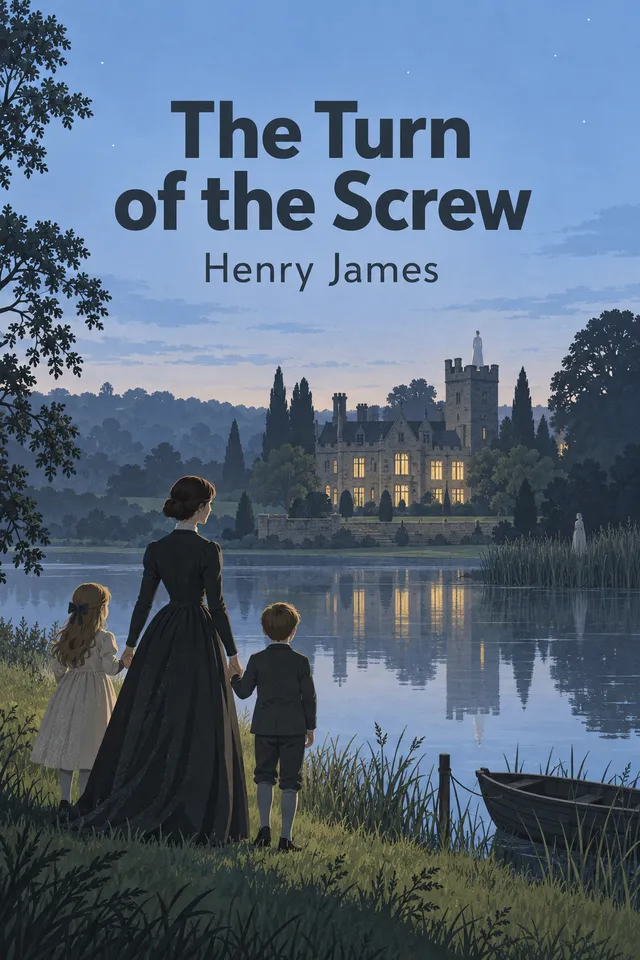
The Turn of the Screw, by Henry James.
At a Christmas gathering, Douglas listens to a tale about an apparition first seen by a boy, then by the boy’s mother when she wakes. He says he knows another case involving a child, and asks what its effect might be with two children. The listeners urge him to tell it. The earlier apparition belongs to a separate story told at the gathering. Douglas’s account reaches us through a manuscript attributed to his sister’s former governess, rather than directly from the woman who experienced it.
The manuscript is in a woman’s hand, written in old, faded ink. Its author has been dead for twenty years. Douglas remembers the governess as exceptionally agreeable. He recalls their garden walks and talks, and says she had been in love with him, though neither spoke of it. Separately, she had seen her prospective employer only twice, and never saw him again after taking the post. He had kept the manuscript locked away for years, then read it to the gathering over several evenings. Before his own death, he gave it to the outer narrator, who presents it to us. Each layer adds distance between the events at Bly and the reader, while Douglas’s attachment makes the act of transmitting the governess’s story personal as well as literary.
The governess’s account begins with her journey to London to answer an advertisement. She is twenty, the youngest daughter of a poor country parson, and is taking service in a schoolroom for the first time. She sees her prospective employer as a rich bachelor, handsome and charming. He has become guardian to his orphaned nephew and niece, and considers their home, Bly, healthy and secure. The boy, Miles, is away at school for the term; his previous governess has died, and school is the only option left for him. The new governess will be responsible for the children’s care at Bly, with Mrs. Grose, the housekeeper, helping look after Flora.
The employer describes the position as a favor she would do for him. He is inexperienced with the children, busy with his own affairs, and impatient with the burdens of guardianship. He sets a strict condition: she must manage questions herself, receive money through his solicitor, and never appeal, complain, or write to him. Other applicants have been put off by these terms. The young woman understands that the job means serious duties, little company, and loneliness. She hesitates for several days, then accepts when she learns the salary is far more than she expected. Her attraction to the employer also matters. When he thanks her and holds her hand, she feels rewarded. The appointment’s terms place her on her own at Bly, but she enters them under the spell of a brief encounter.
After more days of doubt, she travels to Bly. The pleasant June landscape and welcoming house lift her spirits, and her resolve returns. Flora delights her with her beauty, and the generous room she is given makes a good first impression. She is also relieved by Mrs. Grose’s welcome, though the housekeeper seems careful not to show how glad she is to have the new governess there. Flora spends her first night with Mrs. Grose, an arrangement made in consideration of the governess’s inevitable strangeness and Flora’s natural timidity.
The governess quickly decides that watching, teaching, and forming Flora could make a happy and useful life. Rather than begin lessons at once, she gives the child time and attention. They spend the day outdoors, and she lets Flora guide her through the rooms and grounds. This approach makes them friends. Seen through Flora’s charm, Bly resembles a romantic castle. Yet the estate is also a large, old house where the governess feels nearly lost and unexpectedly in charge. Its welcome does not erase the scale of what she has taken on.
On her first night, she faintly hears what might be a child’s cry and light footsteps outside her door. At the time, she dismisses both as fancies. She recalls them only later, after other events have changed how they sit in her memory. The opening does not establish that either sound came from an external cause. Her first response is uncertainty, not a conclusion. That distinction sets the terms for the story ahead: she must interpret a strange household largely on her own, while the reader receives even her earliest impressions through a manuscript carried across several tellers.
Chapter 2 of 9 · 5 min · Audio & textIn the app
Innocence and the First Stranger
The letter about Miles brings an accusation into Bly before the governess has met him. His school says it regrets that it cannot keep him and may not take him back, but gives no particulars.
Chapter 3 of 9 · 5 min · Audio & textIn the app
Giving Names to the Dead
After the earlier sightings, the governess gives Mrs. Grose a fuller description of the man she saw at the window and on the tower.
Chapter 4 of 9 · 6 min · Audio & textIn the app
Children as Possible Witnesses
With the apparitions already linked to names, the governess turns to a different uncertainty: how much the children know. She and Mrs.
Chapter 5 of 9 · 6 min · Audio & textIn the app
A Month of Mutual Silence
The governess now has an explanation from Miles himself, but it answers a narrower question than the one she is asking. As direct encounters pause, her effort to protect the children turns into a theory about what their silence means.
Chapter 6 of 9 · 5 min · Audio & textIn the app
Questions That Break the Truce
After a long stretch of avoiding difficult subjects, Miles asks when he will return to school. He says that spending all his time with a lady is not enough for a boy.
Chapter 7 of 9 · 5 min · Audio & textIn the app
The Lake Confrontation
The lake confrontation begins with a scene that looks almost peaceful. The children have spent the morning in exemplary spirits, and Miles seems intent on easing the governess’s mind.
Chapter 8 of 9 · 7 min · Audio & textIn the app
A Private Promise to Speak
The governess’s decision to contact Miles’s uncle now hangs over a morning already shaped by crisis. Before dawn, Mrs.
Chapter 9 of 9 · 4 min · Audio & textIn the app
Quint, the Window, and Death
At the end of their private conversation, Miles finally begins to answer the governess. He says he opened her missing letter to learn what she had written about him, then burned it.
Chapter 1 of 9 · 5 min · Audio & text: A Manuscript Reaches Bly
Wiseley supports reading and listening to summaries in the app.
Continue in WiseleyWhat The Turn of the Screw is about
A governess’s manuscript reaches readers through Douglas and a later transcriber. At Bly, she cares for two orphaned children and reports seeing their dead former servants; the children and Mrs. Grose do not always confirm her perceptions. What can a caretaker responsibly conclude when her sightings are disputed?