What you'll learn
Key ideas from The Wager
These ideas compress the book's argument without treating the author's view as settled fact. Use them as an orientation before reading the full work or listening in Wiseley.
The Wager’s disaster is seeded by imperial ambition, personal advancement, fragile ships, disease, coercive recruitment, depleted bodies, and unequal patronage before departure.
Fleet separation transformed environmental danger into organizational collapse.
The Kawésqar’s mobility, local technologies, and marine knowledge reveal how poorly the Englishmen understand their environment.
Starvation turns food, burial, and companionship into contested moral choices, exposing how deprivation erodes the settlement’s shared obligations.
Neither faction is morally clean: Cheap retains courage amid compromised authority, while Bulkeley enforces order through threats and abandonment.
After separation, overcrowding, missing supplies, uncertain navigation, and dwindling bodies force every leader to preserve a group by abandoning someone else.
Anson’s ghostwritten and illustrated account gives imperial power the widest, most durable version of British heroism.
Inside The Wager
Read the first chapter in full here. The other 8 continue in the Wiseley app.
Chapter 1 of 9 · 7 min · Audio & text
The Empire’s Floating Gamble
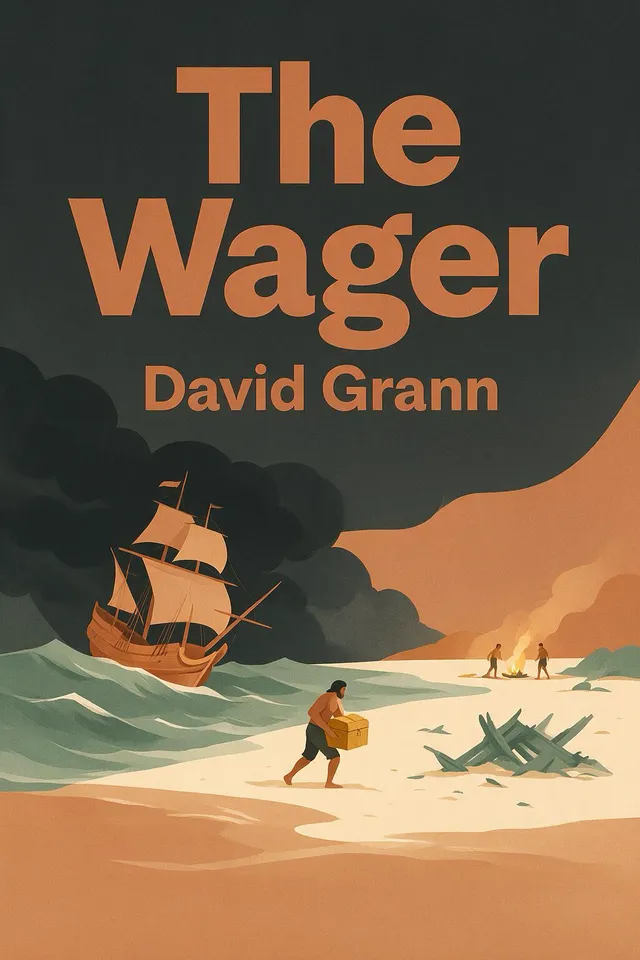
The Wager, by David Grann.
Before HMS Wager becomes a wreck, it becomes a story. In the prologue, a battered improvised boat drifts into an inlet on Brazil’s coast. More than thirty emaciated men are aboard, and one dies soon after landing. They identify themselves as castaways from the Wager, a British warship that left Portsmouth in September 1740 with about 250 officers and crew. The ship has been missing for 283 days. The first arrivals are hailed for ingenuity and endurance. Six months later, three more survivors reach Chile in a smaller dugout. After returning to England, they accuse the Brazil party of mutiny. One ordeal now has two moral shapes: heroic survival or betrayal.
That reversal establishes the book’s contested-evidence frame. Grann did not witness the wreck, the restraint of the captain, or the alleged deceit and murders. He reconstructs events from damaged logbooks, correspondence, journals, court-martial records, and published accounts. The participants witnessed parts of the crisis, but they also shaped it, writing with reputation and punishment in mind. One calls his account faithful; an opponent calls the rival version imperfect and defamatory. The records cannot be made fully consistent. Grann preserves the conflict and leaves the final verdict to the reader. The prologue’s larger point is that people make chaotic lives coherent by selecting, polishing, and erasing memories. For the Wager survivors, credibility could carry literal life-or-death stakes, since a failed defense might end at a yardarm.
Those later stories begin with a mission designed around imperial extraction. Britain’s war with Spain belonged to a wider contest over territory, resources, trade markets, and global commerce, accompanied by Indigenous dispossession, slavery, and claims of civilization. The reported story of Robert Jenkins’s severed ear helped inflame British opinion and produce the War of Jenkins’ Ear, joining revenge to hopes of booty. Anson’s force—five warships, a scouting sloop, and about two thousand men—was sent around Cape Horn to strike Spanish holdings from the Pacific coast of South America to the Philippines. Officially, this was war. In practice, its central prize was a Spanish galleon carrying silver and Asian trade goods. The operation had to proceed secretly and quickly because a Spanish armada under Don José Pizarro might intercept it. Urgency therefore accompanied the promise of wealth from the start.
Anson and David Cheap gave that imperial gamble personal stakes. Anson’s promotion to commodore was unusual because he lacked the patronage enjoyed by many officers, yet the Admiralty recognized his seamanship and calm under pressure. His favor attracted ambitious juniors, and success could let him choose future captains. Cheap, burdened by inheritance conflict, creditors, and debt, saw the sea as a refuge and the expedition as a chance to win a prize, gain command, and prove himself. His competence and restraint earned Anson’s trust. By the time the squadron prepared to sail, Cheap was first lieutenant and close to the captaincy he wanted.
Preparation made the mission more precarious. The Navy’s wooden warships combined advanced sailing and gunnery with materials vulnerable to shipworms, rats, fungus, storms, and neglect. Underfunding and overcrowded dockyards delayed repairs. The Centurion was powerful, but its sheathing was worm-eaten, its foremast rotten, and its sails damaged by rats. The Wager had begun as a cargo-focused East Indiaman and was hastily converted into a low-ranking man-of-war. It needed more than four hundred tons of ballast after nearly tipping, spent two months trapped when the Thames froze, and ran aground while being moved downriver. Meanwhile, the Gloucester received preferential repairs because its captain, Richard Norris, benefited from family influence. Readiness depended not only on naval need but also on whose connections mattered.
The manpower crisis was just as severe. The squadron required unusually large complements, but Britain had exhausted its volunteers and had no conscription. Officials reported that a third of the Navy’s ships were unusable. Before sailing, typhus killed more than twenty-five people and sickened at least two hundred on the Centurion. Overcrowded hospitals and taverns sometimes put three patients in one cot, with more liquor than medicine. Because transmission through lice and vermin was not understood, recruitment could spread danger through the fleet. Cheap and his young nephew were among those exposed.
To fill the ships, press gangs seized sailors in streets and on merchant vessels, confined them in cramped tenders, and separated them from their families. Cheap processed at least sixty-five pressed men despite disliking the practice, but more than 240 men eventually deserted from the squadron. The remaining pool included diseased men, criminals, and other unwanted recruits. The government added 143 inexperienced marines, then rounded up 500 elderly or disabled invalid soldiers. Many deserted; some forced aboard had to be carried on stretchers and seemed to be sailing toward their deaths. Coercion could fill a roster, but it could not create reliable commitment.
After nearly a year of delay, the signal to sail came on August 23, 1740. Collisions, shifting winds, and repeated retreats postponed real progress. On September 18, a favorable breeze finally carried the ships into the open sea, and hopes of treasure and a safe return briefly eclipsed the accumulated dangers. But the disaster had already begun. Imperial urgency, personal ambition, fragile material, disease, coercive recruitment, depleted bodies, and unequal patronage had made catastrophe plausible before the squadron left land. The later arguments over heroism and mutiny would be another struggle over who could turn chaotic survival into a credible story.
Chapter 2 of 9 · 7 min · Audio & textIn the app
The Wooden World at War
To understand the Wager’s floating society, begin with the space it assigned to each body. Sixteen-year-old John Byron slept in the aft orlop deck, a damp, airless level less than five feet high and just above the hold’s foul bilge water.
Chapter 3 of 9 · 8 min · Audio & textIn the app
Cape Horn’s Invisible Siege
After Saint Catherine, the squadron entered the Cape Horn passage with almost no margin for error. Cape Horn and the Drake Passage combined immense currents, hurricane-force winds, huge waves, ice, fog, and shifting weather.
Chapter 4 of 9 · 6 min · Audio & textIn the app
Wreckage and the First Refuge
After the earlier storms, the Wager was crippled and its crew exhausted. Its final approach became a crisis of judgment as much as seamanship.
Chapter 5 of 9 · 6 min · Audio & textIn the app
A Society Made from Salvage
After the Wager disappeared beneath the sea, the castaways had to build a society from what remained. Cheap made salvage their first organized project.
Chapter 6 of 9 · 10 min · Audio & textIn the app
When Hunger Overturns Command
After the Kawésqar left, the settlement lost more than a source of food. It lost the local knowledge that had made survival possible.
Chapter 7 of 9 · 9 min · Audio & textIn the app
Mutiny Without a Verdict
On Wager Island, the argument over the safest route becomes a struggle over who has the right to decide whether the survivors live. Cheap has ignored the petition for three weeks.
Chapter 8 of 9 · 10 min · Audio & textIn the app
Two Roads Out of Wager Island
After the mutiny, separation turns one political crisis into two survival experiments. Each leader must solve the same impossible equation: how many people can a boat carry, how much food remains, and which lives can be preserved when hope itself is running out?
Chapter 9 of 9 · 9 min · Audio & textIn the app
The Verdict That Chose a Story
The ordeal ended only in a narrow sense. After five and a half years, Cheap, Byron, and Hamilton returned to England as men presumed dead.
Chapter 1 of 9 · 7 min · Audio & text: The Empire’s Floating Gamble
Wiseley supports reading and listening to summaries in the app.
Continue in WiseleyAbout David Grann

David Grann is an American journalist and author of deeply researched nonfiction. His books include The Lost City of Z, Killers of the Flower Moon, and The Wager.
Explore more books by David Grann