What you'll learn
Key ideas from The Witches: Salem, 1692
These ideas compress the book's argument without treating the author's view as settled fact. Use them as an orientation before reading the full work or listening in Wiseley.
Puritan providential belief made misfortune a demand for spiritual interpretation, while frontier violence kept danger close.
Hathorne’s questions treated guilt as a premise, shaping the answers that emerged from the first examinations.
Afflicted girls gained unusual public authority as witnesses, while adults and clerks mediated the words preserved in the record.
Bishop was convicted and publicly executed after a trial without defense counsel or cross-examination.
Confessions could look like confirmation while supplying new names, even when pressure, faith, hope, or coercion shaped how they were made.
The new court barred spectral evidence, tried fifty-two cases, and acquitted all but three of the accused.
Adult framing, court decisions to credit uncertain evidence, coercive practices, and political or religious incentives interacted to make accusations lethal.
Political rhetoric and cultural retellings made Salem a flexible symbol, reflecting later concerns more than evidence about 1692.
Inside The Witches: Salem, 1692
Read the first chapter in full here. The other 10 continue in the Wiseley app.
Chapter 1 of 11 · 8 min · Audio & text
Belief, Affliction, and Fracture
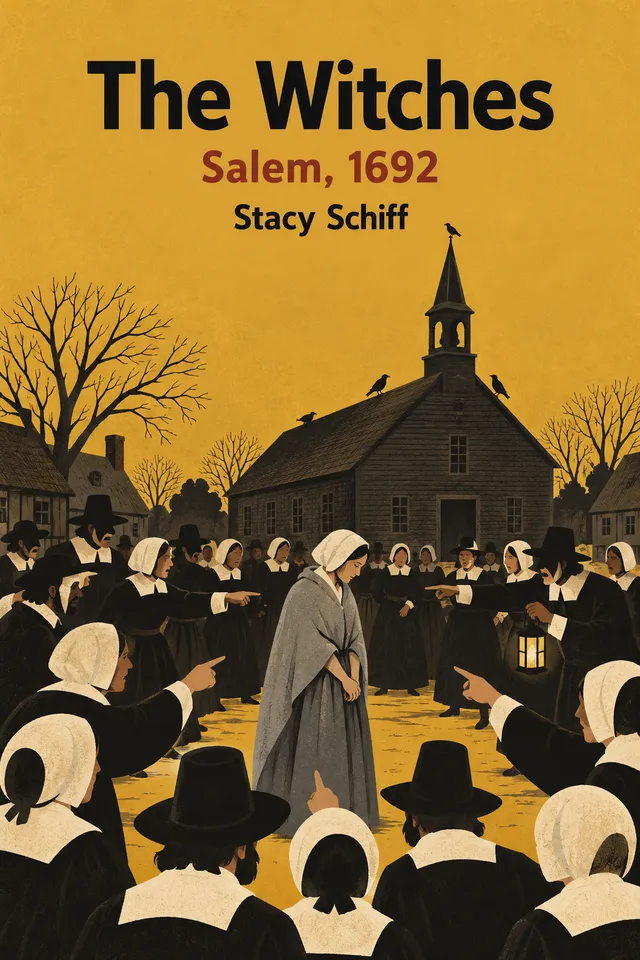
The Witches: Salem, 1692, by Stacy Schiff.
In Salem, a strange illness could become a spiritual warning before anyone knew what had caused it. Puritan life treated scripture as a guide to ordinary disputes and extraordinary events alike. Misfortune might be read as divine chastening, an assault by Satan, or a sign that called for closer attention to the soul. In that world, a supernatural explanation was not an exotic idea added after the fact. It was one of the available ways to make frightening events meaningful.
Danger also felt close in a more physical sense. Memories of King Philip’s War remained vivid, and new raids by Wabanaki people and their French allies raised fears of another conflict. Salem’s frontier settlements had reason to feel exposed. Such fears did not prove that a supernatural threat was present, but they made accounts of danger easier to imagine and harder to dismiss.
Information moved through a small, crowded community without newspapers or much privacy. Salem Village had no more than five hundred and fifty people, and neighbors observed one another closely. Stories passed through conversation and could gather new details as they were repeated. Some accounts that seemed uncanny had ordinary explanations: nighttime noise attributed to an attack on a house, for example, was explained as neighbors dismantling it during a property dispute. Rumor could preserve a report long after its first evidence had become unclear.
The village also had a history of disputes that proved hard to settle. Its residents argued with Salem town over local institutions and obligations, including who should keep watch in a settlement they considered exposed. The village gained an independent parish but remained dependent on the town for some authority. Inside the village, fights over ministers and church governance repeatedly divided neighbors. James Bayley’s supporters and opponents carried their dispute into court, but a ruling could not make him secure in the parish. George Burroughs later left amid unpaid salary and a conflict involving a loan. These episodes made the minister’s place in the community both important and vulnerable.
Samuel Parris entered that strained setting with his own disagreements over salary, repairs to the parsonage, land, and firewood. The village owed him money, and the house and fence needed work. He wanted firewood delivered; villagers preferred to pay into a fund for him to arrange the supply. Those complaints could sharpen existing friction, yet they answered real needs. The winter of 1691 and 1692 was severely cold, and Parris described struggling to preach and study without enough wood. His ministry combined spiritual guidance with practical work and constant negotiation over what the village owed him.
Parris’s sermons also shaped how hardship might be understood. He taught that affliction could humble and instruct the godly, like a parent frightening a child away from danger. For people who shared this outlook, suffering could carry a message. But the idea also raised a difficult question: what sin had made the suffering necessary? Spiritual interpretation could offer meaning while deepening fear and self-scrutiny.
Against this background, reports from the parsonage emerged in late January. Abigail Williams, Parris’s eleven-year-old niece, appears to have been afflicted first, followed by nine-year-old Betty Parris. Accounts say the girls reported bites and pinches from invisible agents. They describe fits that included barking, muteness, contortions, paralysis, frantic gestures, confused speech, hiding, and an attempt to fly. The girls had been well behaved before, and the accounts say they had no fever or epilepsy. These descriptions reach us through partial records made by adults; the girls’ own voices are not directly available. A reported bite, an observed movement, and an explanation involving invisible attackers are different kinds of evidence.
There was a recent precedent for this kind of account. In 1689, the Boston Goodwin children had displayed symptoms that Cotton Mather described as barking, purring, recoiling from invisible blows, contorting, and seeming to fly. Their symptoms could be triggered by religious exercises, household tasks, or reproof. Mather’s account circulated widely enough that Parris could have recognized a resemblance. The parallel gave the Salem reports a familiar shape, but it did not establish that the cases shared a cause.
The household’s illness quickly became public. Visitors came to see the girls; neighbors helped watch and restrain them, while others prayed and sang psalms. Parris continued with prayer and fasting and sought advice. Medical help offered little certainty: local options were limited, and the surviving account does not establish exactly who examined the girls. Reverend John Hale later recalled that neighbors quickly adopted the explanation of an “evil hand,” meaning that someone’s witchcraft was tormenting them. That was a diagnosis within their religious framework, not an independently established cause. Schiff says it likely terrified the cousins, whose symptoms worsened, but this qualified inference does not prove that the diagnosis caused their symptoms.
Mary Sibley, a respected church member, grew dissatisfied with how slowly the mystery was being resolved. She instructed John, an enslaved member of the household, to mix the girls’ urine with rye flour, bake the mixture in hearth embers, and feed it to the family dog. The folk remedy was meant to identify a witch, though its supposed operation was not clear. Its use shows that people could accept witchcraft as a possibility while disagreeing about how to find its source.
Parris rejected the cake as a forbidden form of countermagic, a way of turning to superstition while trying to oppose the devil. Within days of the cake, Betty and Abigail named three people as witches. About a month later, Parris summoned Sibley, reproached her, and received her tearful apology. He then required her to repent before the congregation, warning that the cake had raised the Devil among them. The male congregants agreed, an unusually public moment of consensus in a divided village. Parris did not endorse Sibley’s method, but his rebuke made the episode a shared spiritual concern.
Schiff frames the cake as a catalyst for the girls’ accusations: it “worked its diabolical magic,” and within days Betty and Abigail named three people as witches. That framing links the cake to their naming, but it does not establish what caused the girls’ symptoms. It shows how reports, familiar beliefs, and competing interpretations met in a community already divided over authority. By the time the girls named suspects, spiritual danger was a plausible reading for many participants, and Salem had few trusted ways to resolve the conflicts behind that reading.
Chapter 2 of 11 · 7 min · Audio & textIn the app
From Symptoms to Suspects
On February twenty-ninth, after consulting his minister, Thomas Putnam rode to Salem town with three friends as the girls began naming suspects. A warrant accused Sarah Good of torturing four girls over the previous two months.
Chapter 3 of 11 · 9 min · Audio & textIn the app
Specters Become Evidence
The hearings changed what an accusation could do. In the meetinghouse, a witness’s gestures, an afflicted person’s bodily reaction, and a magistrate’s questions could appear as parts of one event.
Chapter 4 of 11 · 7 min · Audio & textIn the app
Building the Wizard’s Case
As accusations widened in April, they began to sound like parts of one regional conspiracy. Deliverance Hobbs’s changing testimony helped make the connections: her confession linked village afflictions with Putnam’s prophecies, Tituba’s black man, and Abigail’s reference to Maine.
Chapter 5 of 11 · 7 min · Audio & textIn the app
A Court Makes Its Case
By the spring of 1692, Massachusetts was between governments. Local magistrates could investigate accusations and imprison suspects, but grand jury proceedings and indictments awaited permission from the acting governor.
Chapter 6 of 11 · 6 min · Audio & textIn the app
The Trial of Rebecca Nurse
Rebecca Nurse came to trial with a reputation and a community defense that might have seemed powerful. She had not previously been accused of witchcraft or appeared in court.
Chapter 7 of 11 · 9 min · Audio & textIn the app
Confession, Coercion, and Conspiracy
Once an accused person confessed, the court could present the admission as testimony from inside the alleged plot. It also offered interrogators names and details that could lead to new arrests.
Chapter 8 of 11 · 8 min · Audio & textIn the app
Confession, Recantation, and Resistance
By late summer, accusations and examinations were multiplying, and accounts of witchcraft were becoming more elaborate. Repeated questioning brought familiar details into different testimonies, while some witnesses changed or added claims over time.
Chapter 9 of 11 · 8 min · Audio & textIn the app
Doubt Enters the Record
By autumn 1692, criticism of Salem’s trials was growing, but it did not divide neatly between believers and skeptics. Many critics accepted that witchcraft existed.
Chapter 10 of 11 · 7 min · Audio & textIn the app
Aftermath, Causes, and Responsibility
When the proceedings stopped, ordinary life returned slowly. Time spent in court and the loss of workers and property strained households.
Chapter 11 of 11 · 8 min · Audio & textIn the app
Salem’s Long Afterlife
Salem’s story did not end when Massachusetts stopped executing people for witchcraft. It continued as a wound in congregational life, a weakening of religious authority, and a symbol later generations repeatedly reshaped.
Chapter 1 of 11 · 8 min · Audio & text: Belief, Affliction, and Fracture
Wiseley supports reading and listening to summaries in the app.
Continue in WiseleyAbout Stacy Schiff

Stacy Schiff is an American biographer and essayist. “The Revolutionary” explores how Samuel Adams turned disputes over taxation, representation, and military power into collective resistance.
Explore more books by Stacy Schiff