Who Should Have Power?
Compare influential arguments about justice, authority, liberty, democracy, markets, and the relationship between individuals and the state.
Books in this collection
Justice: What's the Right Thing to Do?
Michael J. Sandel’s Justice asks how to decide what people owe one another when welfare, freedom, equality, desert, virtue, and loyalty collide. Moving through competing theories and hard cases, it shows why fair institutions require public reasoning about human purposes and the common good, not only calculation or choice.
The Republic
Plato’s Republic asks whether justice is valuable in itself or only for its rewards. By building a model city and comparing it with a soul ruled by reason, it examines education, philosopher-rule, regime failure, pleasure, art, and the soul’s fate. Its value lies in clarifying how political arrangements and inner character shape one another.

The Prince
The book asks what enables a ruler to acquire, secure, and preserve political power. It connects regime structure, military foundations, public conduct, reputation, counsel, and Fortune, then turns Italy’s crisis into a test of those principles. Its value is a compact framework for judging when authority becomes durable rather than merely successful.
The Social Contract
Rousseau asks how people can enter political society without surrendering freedom. He argues that legitimate authority rests on a reciprocal compact, laws expressing a general will, and citizens who remain active lawmakers. The book then tests this ideal against government, representation, civic institutions, history, and religion, clarifying both its power and its risks.
On Liberty
John Stuart Mill asks when society may restrain a person’s thought, speech, choices, and way of life. He argues for a harm-based limit on coercion, defends dissent and individuality as conditions of truth and progress, and tests the principle against social pressure, government, education, and slavery.
Democracy in America
Alexis de Tocqueville asks how equality reshapes political institutions, civic habits, culture, and private life—and why democracy can foster both liberty and dependence. This summary follows his argument from America’s colonial origins and local self-government through majority power, racial conflict, and centralization, offering a framework for understanding the conditions that sustain freedom.
The Communist Manifesto
How does capitalism create both immense productive power and the class capable of challenging it? This audio-first summary traces historical materialism, bourgeois expansion, exploitation, crisis, proletarian organization, revolutionary transition, and communist freedom. It clarifies how diagnosis becomes political strategy and where the argument remains historically qualified.
The Road to Serfdom
Why can an attempt to organize prosperity and security end by narrowing freedom? The book traces how comprehensive planning replaces competition, general rules, and personal choice with discretionary control, then follows the consequences for democracy, truth, social character, totalitarian politics, and international order. It clarifies the choices involved in preserving liberty.
Capitalism and Freedom
Capitalism and Freedom asks how a society can coordinate economic life without surrendering individual choice. Friedman links competitive markets to political liberty, then tests that relationship through money, trade, education, discrimination, monopoly, occupational licensing, taxation, welfare, and poverty relief. The result is a framework for judging when government protects freedom—and when it expands coercion.
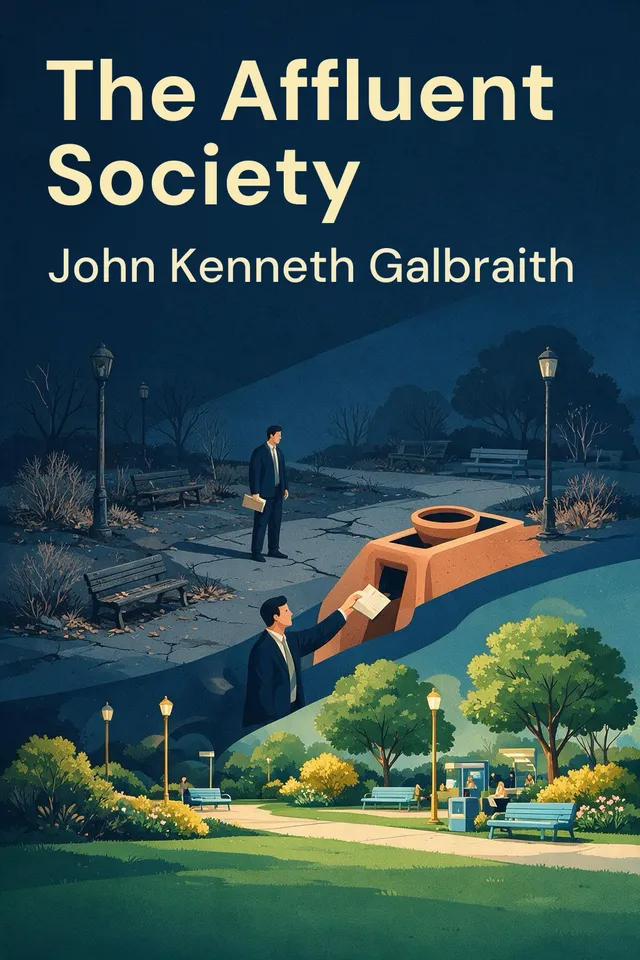
The Affluent Society
Galbraith asks what an affluent society should value once private goods are abundant but public needs remain neglected. He traces how scarcity-era economics, manufactured wants, debt, inflation, and investment priorities preserve production as the main test of progress, then argues for poverty relief, education, humane work, public services, and survival.